Slow dispatch chain: dispatch 1 calls dispatch 2 which alerts intervention teams. Each link adds delay. In a fire, every minute counts.
Fire services and first responders
From 911 to firefighters in seconds, with confirmation
IPA compresses the chain between the 911 alert and the response: direct connection, simultaneous delivery to on-call firefighters, real-time station display, station equipment activated automatically. Every step is tracked — receipt, acceptance, travel to site.
Sector challenges
Our answer
Direct 911 connection, no intermediate chain
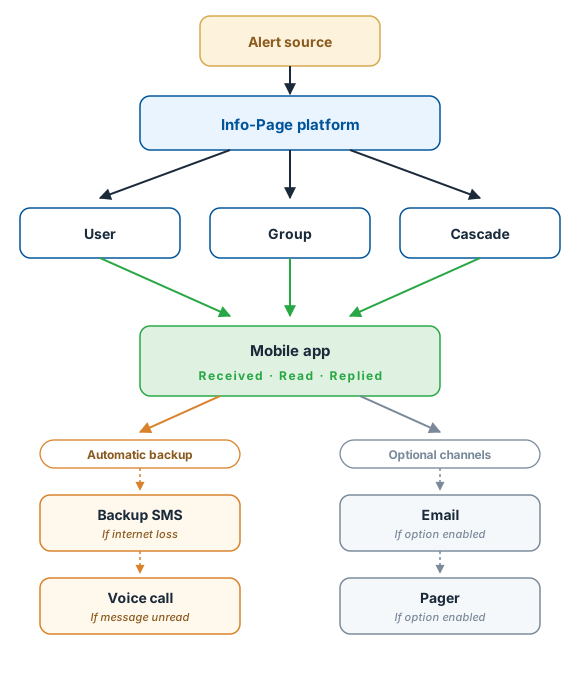
IPA connects directly to one or several 911 dispatches and to fire service leads. No dispatch-to-dispatch chain: the alert reaches on-call firefighters immediately, on all channels in parallel (app, SMS, voice).
Blind officer: en route to the intervention, no way to know who is coming, how many, or when. Decisions made with incomplete information.
Station display and tablet: strike force in real time
Full-screen display in the station: incident type, address, map, firefighters confirming in real time. Same data on tablet with more detail (fire hydrants, water access points, route maps). The officer sees the strike force gathering and adjusts deployment.
Over-mobilization by safety: to be sure of enough personnel, everyone is paged. High cost, firefighters mobilized for nothing.
Cascade and schedules: just the right number
On-call schedules and cascades mobilize only the firefighters actually needed. If 6 are enough, the other 20 on the list are not disturbed. Major savings without sacrificing coverage.
Alerts missed at night: phone on silent or DND, notification lost in the social media and personal SMS feed. No clear indication it is the fire service alert.
Silence-proof app: reliable wake-up at night
The IPA app overrides silent mode AND Do Not Disturb for critical alerts. Volume and ringtone configurable per firefighter. SMS and voice call as backup if the app fails. No way to miss a night alert.
Station equipment to activate manually: strobe lights, siren, lights, gas cutoff, door opening — each step delays departure.
Webrelays: the station activates automatically
Trigger station equipment in parallel: strobe lights, siren, door opening, gas cutoff, lights. Webrelays fire at the same instant as the firefighter alert — zero manual manipulation.
A 911 call, 4 seconds, a service in motion
911 dispatch triggers the alert for a structure fire.
Within 4 seconds, the whole service is in motion: at the station, the screen shows the address and map, strobe lights activate, the siren sounds, gas is cut off. Off-site, volunteer firefighters receive the alert on their phone with the dedicated IPA ringtone — even on silent or Do Not Disturb.
Each firefighter responds with one tap: heading to the station, going directly to the scene, or unavailable. The officer sees in real time who is coming to grab the truck and who is converging straight to the address, on the station screen and on their tablet (fire hydrants, water access points, route maps).
Precision mobilization, not bulk paging: groups define who is contacted, on-call and calendars know who is available, cascades extend the call if the required number is not reached within 90 seconds. Just the firefighters actually needed, real cost savings, and everything is logged for the post-incident report.
One alert, one tap, one role
The app supports every responder — volunteer firefighter, officer, station chief — from notification to intervention:
- Wake-through alarm. Dedicated ringtone of choice, strong vibration, overrides silent mode and Do Not Disturb. SMS and voice call backup if the app does not respond.
- One-tap action. Right from the notification: heading to the station / going directly to the scene / unavailable. After accepting, the route opens automatically to the right destination.
- Live coordination. See colleagues' responses in real time, the strike force gathering. The officer can also page a group or specific firefighters from the app, without going back to the desk.
- Personal management. My on-call groups, availability calendar, ON/OFF switch to flag myself unavailable for a few hours (day off, training, post-incident rest).
- Role-based access rights. Firefighter, officer, station chief, fire service administrator — each user sees and does exactly what their role allows.
Wake-through alarm
even at night
- Dedicated ringtone
- Overrides silent + DND
- SMS & voice backup
One-tap action
Right from the notification
- Station / scene / unavailable
- No need to open the app
- Route opens automatically
Live coordination
Field and station
- Team responses in real time
- Strike force visible
- Officer pages from the app
My settings
From your phone
- My on-call groups
- Availability calendar
- ON / OFF switch
Role-based access rights
firefighter · officer · station chief · fire service admin
100+
municipalities across Quebec have already adopted IPA for their fire service
Frequently asked questions
How do you receive 911 alerts?
Several options: classic SNPP gateway, HTTP webhook from your CAD, structured email, or SMS. Multiple dispatches or fire service leads can reach firefighters directly without going through an intermediate chain. Integration is tailored to your current dispatch setup.
Does it work in low-cellular-coverage areas?
Yes. IPA sends the alert via SMS, voice call and mobile app in parallel: if one channel fails, the others take over. Firefighters in low-signal rural zones reliably receive via SMS or voice.
Can we keep pagers in parallel during transition?
Absolutely. IPA broadcasts simultaneously to pagers (via SNPP) and phones. Firefighters adopt the app at their own pace without losing their habits.
Does the station display need specific hardware?
No. A TV or monitor with a mini-PC or Chromecast is enough. The display is a full-screen webpage that refreshes automatically. Tablets use the same interface with more contextual information (fire hydrants, water access points, route maps).
What equipment can I automate via webrelays?
Any equipment controlled by an electric relay: siren, strobe lights, station lighting, automated door openers, gas cutoff, ventilation systems. IPA fires webrelays at the same instant as the firefighter alert — zero manual handling, faster departure.
How does pricing work for a fire service?
Per-enrolled-user pricing, from $4 / user / month. No per-device contract, no hardware. Compared to a pager fleet (rental, batteries, replacements), it is more predictable and often cheaper. Prices + taxes.
365 × 24/7 support — infrastructure in Quebec
The solidity a critical infrastructure demands.
24/7 human support
Our team is reachable at all times. No bot, no lost ticket — engineers who know your deployment.
Hosting in Quebec
Servers located in Quebec, compliant with Quebec's Bill 25. Your data stays on Canadian soil.
Redundant infrastructure
Redundant servers, encrypted backups, 24/7 monitoring. Availability is our foremost commitment.
Try IPA in your fire service — no commitment
Full account created in minutes. A team that understands 911, SNPP and field deployment. Already adopted by more than 100 municipalities across Quebec — your turn?